Tuesday, November 4, 2014

Jack S
11/5/14
Arrow of the Blue-Sinned God

                                     Thoughts and Reflections on: The Caste System

The caste system is a social system that has been in India for a thousands of years. It was created by the god, Manu. The system is based on the body of Manu. The head represents the Brahmins or the priests, the biceps represents the Kshatriyas which are the Warriors, the thighs represent the vashyas which are the merchants, and the feet represent the sudras which are the slaves. There is another group of people called the untouchables which are people who are total outcasts in their communtiy. One may think that the untouchable are part of the caste system, but they are not. The caste system in India untied India, but also divided it. Every person in India was part of a caste which brought them closer together with their caste and made it feel like more of a family or team. On the other hand, the caste system created social stratification. This meant that some people were treated better than other or some people were higher than others. The caste system was brought to India in the first place by the Aryans. The Aryans are a group of people from Central Asia who migrated into north India and conquered it. They brought new things to India like the caste system and the Vedas. The caste system was and continues to be one of the largest distinguishing characteristic of Indian society. The caste system continues to be around today because such a big part of a community does not just fade away over time. People in India have followed the caste system for their whole lives as well as their ancestors did, so it has always had such a drastic impact on people's lives and really what people are able to accomplish in their lives. A system with such a huge impact will not disappear very easily throughout time.  


Thursday, October 30, 2014

Digital Scrapbook Entry #3

Digital Scrapbook Entry- Mesopotamia 

Jack S.
11/3/14
Per. 4

Links- Author: Unknown 
           Author: Unkown 
           Author: Munich watcher
           Author: Unkown
           
           
                                                             The Power of Beer

In Mesopotamia beer was one of the biggest parts of their culture. The process of making beer, or fermentation, brought many new innovations to Mesopotamia including a new type of currency, shorthand writing, and just made people happy in general. Beer was a fascinating new beverage and people enjoyed drinking it. Beer was more flavorful than water, but the wheat and barley in it actually gave it nutritional value. With these advantages over other beverages beer soon became the most popular drink in Mesopotamia. Beer would be widely consumed in large groups and at social gatherings. Does this sound familiar? 


In today's world, beer is still one of the most popular drinks globally. At Oktoberfest last year over 6.7 million liters of beer were consumed by 6 million people. This is a prime example of the power of beer. People enjoy drinking beer together as a bonding activity which creates friendships. Events like Oktoberfest makes people happy and gives them a chance to have fun and the only reason Oktoberfest is around is because of beer. In 2012 there was over 55.1 billion gallons of beer sold in the United States alone. With how much beer is bought and consumed it makes quite a big economic splash as well. Beer has an annual 10 billion dollar segment which is pretty impressive for a beverage.  Overall, beer has had a positive effect on the modern day world.  


Beer is an image of fun, excitement, and happiness throughout history and will continue to be for a long time. Without the Mesopotamians invention of beer the United States couldn't bring in 10 billion dollars annually and we wouldn't be able to have the thousands of jobs created by breweries, but most of all we wouldn't be able to have as good of a time as possible. Beer is a surprisingly important part of American culture and many other cultures around the world and without it people would lose part of their culture and lose something that they love. A good beer has brought smiles to people faces since the days of ancient Mesopotamia and will continue to bring smiles to people faces for as long as we will live.   

Wednesday, October 22, 2014

Jack S.
10/23/14
Per. 1

                                                              Life After Death

The sarcophagus was important to the Egyptian after life because whatever items or goods was in or near their sarcophagus went with them to the afterlife. If this belief was the same in our world today people would go above and beyond for their loved ones to give them a great afterlife. Sarcophagi made people successful in the afterlife if they are buried with things they love and lots of luxuries. This practice shows that Egyptians felt very strongly in their religious beliefs and were very superstitious. With Pharos, who were living gods, in the Egyptian  community the people got a glimpse of the gods moods and what gods were like, so this probably made them much more firm in their belief of religion. With such firm religious beliefs, the Egyptians went above and beyond when it came to a sarcophagus and death.

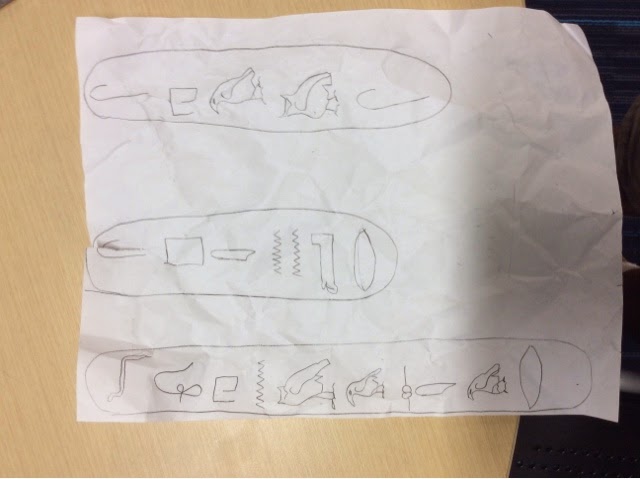
My Egyptian Name

Thumbnails

Sarcophagus

Tuesday, October 14, 2014

Jack S.
10/16/14
National Geographic

Thoughts and Reflections on: A Light That Did Not Fail

Ancient Mesopotamia was a very ethnically diverse place. The people to thank for this is the Sumerians. The Sumerians traveled to Mesopotamia leaving their immediate families behind somewhere els in Asia. The Sumerians way of life mixed so well with the Mesopotamian lifestyle that they decided to stay. The result of this was the evolution of an entire civilization. Adding in this entirely different ethnicity to the mix made Mesopotamia a much more diverse place. The Mesopotamians were very superstitious people and always thought the gods were mad at them. They would do anything to try to appease the gods. They would even rebuild their temples in the exact same spot to earn the protection of the gods and spirits that previously lived in them. Some aspects of  the Mesopotamian lifestyle we still use today. For example, they were the first Civilization to have a written form of communication which is still used across the world today. The Mesopotamians also used canals to irrigate their crops. This is also used across the world today and one of the most popular forms of irrigation.